

Prakhar Gupta
- Why businesses are moving beyond traditional warehouses
- How Snowflake’s cloud-native design redefines data warehousing
- Snowflake vs. traditional systems: a modern comparison
- Real-world ROI: The 5GB Dataset Challenge
- Key features: Time Travel, Fail-Safe, and Snowpark
- Migration considerations and best practices
- Maximizing value from your Snowflake investment
- The bottom line: a new era of data warehousing
A common question arises: “If traditional data warehouses already store and query data effectively, what’s missing?”
The reality is that legacy systems struggle to meet today’s scale, speed, and cost-efficiency demands.
Common challenges include:
- Rigid scalability: When workloads spike, performance drops or costs skyrocket.
- Coupled compute and storage: You pay for both, even if you only need one.
- High operational overhead: Hardware, licensing, and manual tuning up budgets.
- Performance bottlenecks: As teams multiply, concurrent queries slow everything down.
These inefficiencies have driven organizations to explore Snowflake’s cloud-native alternative — a platform purpose-built for elasticity, intelligence, and cost control.

Naturally, the next question is: “How does Snowflake address these long-standing challenges?”
Snowflake isn’t just another warehouse in the cloud — it’s a complete architectural reimagination of how modern data platforms should work.
Key innovations include:
- Separation of compute and storage: Scale independently based on workload.
- Elastic scalability: Scale up or down automatically, paying only for active computation.
- Multi-cluster architecture: Multiple teams can query simultaneously without contention.
- Intelligent caching: Query once, reuse results instantly — at zero additional cost.
- Automatic micro-partitioning: Data is automatically optimized for faster queries.
This cloud-first design eliminates manual tuning, reduces waste, and enables true real-time analytics.
| Feature | Traditional Data Warehouses | Snowflake |
|---|---|---|
| Architecture | Primarily on-premises; limited cloud support | Fully cloud-native, multi-cluster |
| Scalability | Hardware-bound, manual tuning | Elastic, near-infinite scaling |
| Compute & Storage | Coupled and interdependent | Decoupled, scale independently |
| Concurrency | Performance drops under heavy load | Multi-cluster warehouses remove contention |
| Caching | None or limited | Intelligent, multi-layer caching |
| Data Sharing | Complex ETL or duplication required | Seamless, secure live data sharing |
| Cost Model | High upfront license and infra costs | Pay-as-you-go, per-second billing |
| Administration | Manual tuning required | Fully managed, zero maintenance |
The difference isn’t incremental — it’s architectural. Snowflake was built for flexibility, concurrency, and scale from day one.
Here are real-world scenarios where Snowflake consistently outperforms legacy systems:
- E-commerce scalability: Handles massive seasonal traffic spikes effortlessly.
- Financial data sharing: Enables live, secure data exchange between partners without duplication.
- Multi-cloud flexibility: Operates seamlessly across AWS, Azure, and GCP.
- Operational simplicity: Frees data teams from infrastructure management to focus on insights.
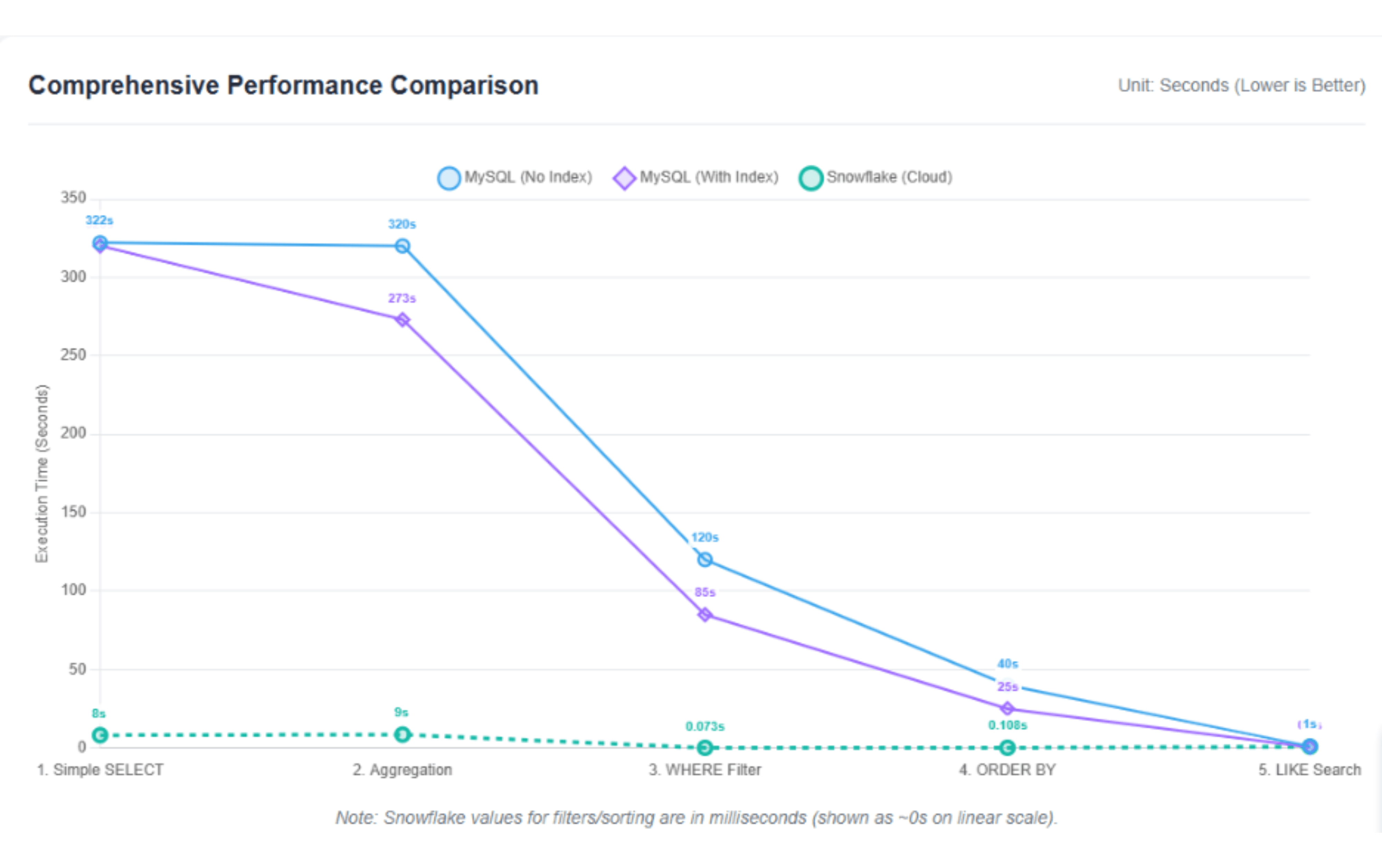
To measure real-world performance differences between a cloud-native analytical warehouse and a traditional relational database, a 22M-row dataset (~4–5GB) was loaded into MySQL (on-prem) and Snowflake (cloud) for side-by-side benchmarking.

Setup
1.Data Volume
- 22 million rows in a BIG_DATA table
2.Workloads Tested
- SELECT queries
- Aggregation (SUM + GROUP BY)
3.Data Load
- MySQL: Loaded via Python-based ingestion scripts, manual indexing added later
- Snowflake: Loaded via Python-based ingestion pipeline (automatic partitioning & internal optimization)
Performance Comparison
| Metric / Query Type | MySQL (Without Index) | MySQL (With Index) | Snowflake (Cloud) |
|---|---|---|---|
| Full TableScan (Simple SELECT) | 5 mins 22 sec | ~5 mins 20 sec (Index doesn't help) | 8.1 sec |
| Aggregation (SUM + GROUP BY) | 5 mins 20 sec | Improved (4 mins 33 sec) | 8.5 sec |
| WHERE Filter Query (value > 5000) | Slow (2 mins) | Fast (1 min 25 sec) | Fast (73ms) |
| ORDER BY + LIMIT / TOP | Very slow (40 sec) | Fast (25 sec) | Fast (108ms) |
| LIKE Search (name LIKE 'A%') | Medium (1 sec) | Fast (Less than 1 sec) | Medium-Fast (no B-tree index but pruning helps) |
| Indexing Approach | ❌ No indexes → slow | ✔ Manual CREATE INDEX required | ✔ Automatic micro-partitioning; no manual index needed |
| Concurrency Scaling | Limited → manual tuning | Limited → index helps but not scaling | Automatic multi-cluster scaling |
| Admin Overhead | High (tuning, index mgmt.) | High (choose & maintain indexes) | Zero (self-optimizing) |
Result
Benchmark results showed:
- Snowflake delivered 30–40× faster performance than MySQL for SELECT and aggregation workloads.
- Snowflake required no indexing or tuning, while MySQL required manual index creation for acceptable performance.
- Even with indexes, MySQL remained ~10× slower.
Snowflake’s internal indexing, elastic compute, automatic partition pruning, and intelligent caching provided instant analytical speed with zero DBA effort — making it not just an improvement, but a complete performance transformation.
1. Time Travel: Your Built-In Data Insurance
Recover data from any point in the past (up to 90 days) — whether from an accidental DELETE or a failed ETL job.
-- Query historical data SELECT * FROM sales AT (TIMESTAMP => '2024-10-15 14:30:00');
-- Restore dropped table UNDROP TABLE critical_customer_data;
Snowflake’s Time Travel ensures safety, compliance, and recovery flexibility — at minimal storage overhead.
2. Fail-Safe: Your Last Line of Defense
Even beyond Time Travel’s 90-day window, Snowflake maintains an additional 7-day Fail-Safe period. This recovery layer, managed by Snowflake’s internal team, ensures your data can be restored even after catastrophic loss.
3. Snowpark: Bringing Computation to the Data
Instead of exporting massive datasets for analysis, bring your logic to the data.
With Snowpark, developers and data scientists can write Python, Java, or Scala code that executes directly within Snowflake’s compute layer:
from snowflake.snowpark import Session from snowflake.snowpark.functions import col, avg
session = Session.builder.configs(connection_params).create() df = session.table("sales") \ .filter(col("region") == "APAC") \ .group_by("product_category") \ .agg(avg("revenue").alias("avg_revenue"))
df.write.mode("overwrite").save_as_table("apac_revenue_summary")
No data movement. No security risks. Just faster, in-place data science.
It’s fair to ask: “If Snowflake is so powerful, why hasn’t everyone migrated yet?”
Valid considerations include:
- Cost governance: Pay-as-you-go flexibility requires monitoring and control.
- Learning curve: Teams must adapt to new concepts like virtual warehouses and caching.
- Platform dependency: Adopting Snowflake means aligning with its ecosystem.
- Workload suitability: Predictable, static workloads may remain more cost-efficient on-prem.
Understanding these factors ensures a smooth and cost-efficient transition.
At Gemini Solutions, we’ve helped enterprises across industries migrate, optimize, and scale Snowflake environments to achieve measurable ROI.
Our areas of expertise include:
- Migration Strategy: Seamless shift from Oracle, SQL Server, or Teradata.
- Performance Optimization: Right-sizing warehouses and implementing clustering efficiently.
- Security & Governance: Row-level security, data masking, and compliance frameworks.
- Snowpark Enablement: Building scalable data science pipelines within Snowflake.
- Cost Management: Automated scaling, monitoring, and spending control.
We don’t just deploy Snowflake — we help you master it.
Snowflake isn’t an upgrade — it’s a paradigm shift.
It transforms data warehousing from rigid, manually tuned systems into an elastic, intelligent, and cost-optimized platform. With intelligent caching, micro-partitioning, elastic scaling, and built-in data protection, Snowflake delivers speed, agility, and efficiency that legacy systems simply can’t match.
Whether you’re analyzing 10GB or 10PB, Snowflake scales seamlessly — empowering your teams to focus on insights, not infrastructure.
Ready to modernize your data strategy? Snowflake enables you to store, scale, and share data effortlessly — unlocking the full potential of the cloud era.


Blogs you may like
There are no more blogs for this category