

Prakhar Gupta

- Real-world data quality challenges in large-scale enterprise pipelines
- Validation techniques applied across ingestion, transformation, and analytics layers
- How metadata-driven rule engines enable scalable validation
- Data quality monitoring, alerting, and observability in practice
- Measurable business outcomes achieved through automated validation
As organizations expand their use of data for analytics, machine learning, and operational reporting, the reliability of that data becomes just as important as its availability. For one enterprise organization, growing data volumes and increasing pipeline complexity began to expose weaknesses in the way data quality was being managed.
While data delivery timelines were being met, confidence in the accuracy of that data steadily declined. Validation checks were fragmented, issues surfaced late in the process, and business teams increasingly questioned analytical results. Over time, this erosion of trust started to impact decision-making and operational efficiency.
To address these challenges, the organization implemented a structured data validation lifecycle that embedded automated checks throughout the data pipeline. This approach shifted validation from a reactive activity into a built-in system capability, leading to measurable improvements in data reliability, visibility, and business confidence.
The organization operated multiple data pipelines sourcing information from transactional systems, third-party providers, and flat-file uploads. As the data ecosystem expanded, several recurring issues began to surface:
- Conflicting metrics across reports and dashboards
- Data issues discovered only after stakeholders raised concerns
- Validation logic spread across custom scripts with no clear ownership
- Limited visibility into overall data pipeline health
- Growing mistrust in analytics, particularly within finance and customer domains
Together, these challenges resulted in slower decisions, repeated analysis cycles, and increased operational risk.
The goal was not simply to add more checks, but to establish a validation framework that could scale alongside the organization’s data growth while remaining consistent and transparent.
The initiative focused on:
- Identifying data issues as early as possible in the pipeline
- Standardizing validation rules across all datasets
- Making data quality health visible and measurable
- Reducing reactive firefighting through early intervention
- Rebuilding confidence in both analytical and operational data
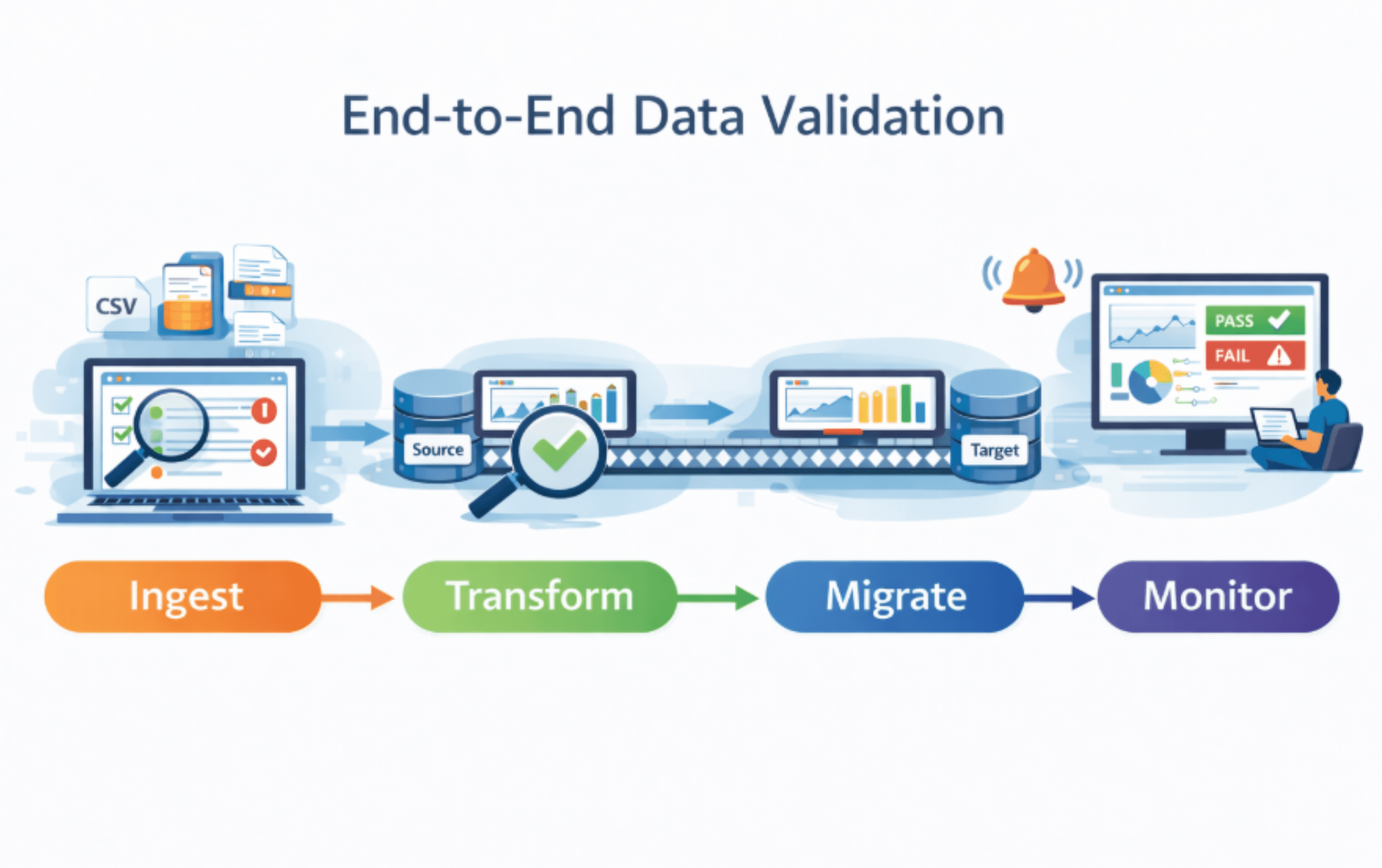
Instead of treating validation as a single checkpoint, the organization redesigned it as a continuous process spanning the entire data lifecycle. At each stage, validation answered a simple but critical question: Can this data still be trusted?
1. Ingestion Validation
Validation began as soon as data entered the platform. Foundational checks ensured structural correctness before any downstream processing occurred.
These checks included schema alignment, data type validation, mandatory field enforcement, and file-level integrity checks such as format and record counts.
Outcome: Incorrect or malformed data was blocked early, preventing downstream contamination.
2.Structural and Referential Checks
Once ingested, the data was evaluated for internal consistency. This ensured that relationships between datasets remained intact as data volumes grew.
Checks focused on primary key uniqueness, referential integrity, duplicate detection, and validation against reference datasets.
Outcome: Dataset relationships remained consistent, reducing the risk of silent analytical errors.
3.Business Logic Validation
Structural correctness alone was not enough. To ensure the data reflected real-world expectations, business-specific rules were applied.
These included detection of invalid or extreme values, cross-field dependency checks, enforcement of domain rules, and identification of unusual deviations from historical patterns.
Outcome: Data that was technically valid but business-incorrect was automatically flagged.
4.Transformation and Reconciliation Checks
As data moved through transformations, additional controls ensured that accuracy was preserved and logic changes did not introduce unintended effects.
Validation included source-to-target reconciliation, aggregation consistency checks, row count comparisons between stages, and detection of transformation-induced drift.
Outcome: Transformations became transparent, auditable, and easier to trust.
5.Monitoring and Observability
All validation results were captured in a centralized monitoring layer, providing ongoing visibility into data quality.
Teams used dashboards to track validation status, received automated alerts for critical failures, and analyzed historical trends to identify recurring issues.
Outcome: Data quality became visible and actionable rather than hidden and reactive.
To ensure scalability and maintainability, the validation framework was built using a configuration-driven approach. Validation rules were defined as metadata rather than embedded directly into pipeline code.
This design enabled reusable validation patterns, faster onboarding of new datasets, version control of rules, and seamless integration with existing orchestration workflows. Validation execution was fully automated, ensuring consistent enforcement without manual intervention.
| Metric | Prior State | After Implementation |
|---|---|---|
| Time to detect data issues | Multiple days | Within minutes |
| Manual validation effort | High | Minimal |
| Data-related production incidents | Frequent | Reduced by ~60% |
| Confidence in reporting | Low | Strong |
| Audit preparedness | Manual | Automated and traceable |
As the organization’s data landscape expanded, risk grew alongside it. Data flowed in from internal systems, legacy platforms, and external providers—on time, but not always accurate. Finance teams questioned numbers, dashboards conflicted, and engineers spent too much time fixing issues after the fact.
The shift came when validation was redesigned as a single, continuous flow rather than scattered checks.
-
It starts at ingestion. As soon as data enters the platform, automated checks validate schema, structure, and mandatory fields. Broken files, missing columns, and malformed provider feeds are stopped before reaching reports or models.
-
Business logic comes next. Technical validity isn’t enough. Financial datasets now enforce clear rules—such as days to maturity staying between 0 and 365—while operational metrics are protected from unexpected negative values. Data that doesn’t make business sense is flagged immediately.
-
Trust continues through transformation and migration. Automated reconciliation checks compare row counts, aggregates, and relationships at every stage, ensuring data remains accurate as it moves and changes.
-
External data is held to the same standard. Third-party feeds are monitored for schema drift, missing values, and quality degradation, allowing teams to isolate issues early without disrupting analytics.
All of this is powered by a metadata-driven Data Validation Framework (DVF) with Data Quality Automation (DQA). Rules are defined once, reused across datasets, and executed automatically, with results visible through dashboards and alerts.
The impact is clear. Issues are detected in minutes instead of days, manual checks largely disappear, production incidents drop significantly, and business teams regain confidence in their data.
In short: a unified validation flow now protects data from ingestion to analytics, turning data quality into a built-in strength rather than an ongoing concern.
The impact of the validation lifecycle extended beyond technical improvements:
- Business teams regained confidence in dashboards and reports
- Engineering teams spent less time troubleshooting and more time improving the platform
- Data issues were identified and resolved earlier
- Validation scaled naturally as data volumes increased
- Governance and compliance processes became easier to support
By adopting a structured data validation lifecycle, the organization transformed data quality into a core platform capability rather than a reactive afterthought. Validation became continuous, automated, and visible across the data ecosystem.
This case demonstrates that data trust is not built through isolated checks or manual reviews. It emerges from a disciplined, end-to-end validation approach that evolves alongside the data itself.


Case Studies you may like
There are no more case studies for this cateory.